System engineers
Model the circuit once
Import existing topologies or draw them in the visual Circuit Builder. Every change is a numbered revision with a name on it, and everyone downstream sees the issued drawing immediately.
NodeFabric gives engineers, operators, and field crews a live, shared one-line of the circuit — and a safer, auditable way to plan and execute switching. Operate devices on the model, watch energization update, hold-tag what must not be touched, and run every switching order against the diagram instead of a piece of paper.
Illustrative feeder. Switching and energization state are simulated for demonstration — see real screenshots below.
Model it. Issue it. Plan it. Execute it. NodeFabric gives engineering, operations, and field crews one shared distribution model for diagrams, switching, clearances, and training.
Every circuit modeled, revision-controlled, and operable on screen — office or pole.
Scenarios built from real switching orders, scored, and run without touching the live model.
Clearances, overrides, certifications and every step execution, named and timestamped.
Every role works from the same up-to-date circuit model — not a PDF from last year, a GIS export on someone’s desktop, and a markup nobody else can see.
Import existing topologies or draw them in the visual Circuit Builder. Every change is a numbered revision with a name on it, and everyone downstream sees the issued drawing immediately.
Operate devices directly on the diagram and watch energization — including backfeed from online DER — update in real time. A live sandbox for the plan before any switch is thrown in the field.
Every switching step shows the exact device highlighted in the live one-line, from any device with a browser. Pin the circuit before you leave and it still opens where there’s no signal.
Diagrams, the interactive circuit model, clearances, and switching orders read from the same live data — so they can’t drift out of sync.
Modern, interactive one-lines for every distribution circuit — searchable, zoomable, printable, and accessible from the control room or the field.
Open a switch on the model and energization is re-traced from the modeled topology — including sections backfed by DER marked online, shown separately from grid-fed line. A simulation of the circuit, not a SCADA telemetry feed.
Build orders step by step with an authored restoration section, assign steps to individuals, and execute against the live diagram so circuit impact is visible as it happens.
Place a do-not-operate tag on a device and the platform blocks operating it — in simulation and in a switching-order step alike. Only an operator can override, only with a reason, and every override is recorded permanently.
Every drawing carries a revision number and a revision block behind it. Compare any two revisions device by device, and restore an earlier one as a new revision — nothing is overwritten.
Turn it on and a builder edit becomes a draft, not a live change. Written by, checked by, approved by — three names on the title block, and the author can’t approve their own work.
Pin a circuit before the truck leaves and the one-line opens with no connection — read-only, scoped to what was pinned, and expired after 12 hours so nobody works from stale data.
Drag-and-drop the full distribution palette — breakers, reclosers, sectionalizers, switches, fuses, ties, regulators, transformers, capacitors, loads — plus solar, wind, generators, and batteries.
A tie switch points at its far-side device — including devices on other feeders at the same station — so alternate sources are explicit on the drawing instead of tribal knowledge.
Each device carries phase, voltage, state and normal position alongside pole, FLOC, line/road, and customers served — and anything off its normal position is flagged on the diagram.
Load topologies in bulk from CSV — multiple circuits per file — with a diff preview before anything commits. Export circuits back to CSV, or a clean one-line to PDF with title block, revision, and legend.
Every status change, step execution, remark, and tag override records who did it and when. When someone asks what happened on last Tuesday’s order, the answer is one click.
Model the circuit, issue the drawing, plan the switching, and execute it in the field — four stages, one set of data, one record of who did what.
Import an existing topology and NodeFabric shows you a full diff — added, removed, and changed devices — before anything writes to your circuits. Or skip the export entirely and draw the circuit in the visual builder, wiring devices together on the canvas with validation as you go.
A one-line that gets operated against needs what a paper drawing has: a revision number, a record of what changed, and names against it. Every edit writes a revision — major issues advance the number, minor amendments hang off it — and nothing is ever overwritten. Turn on the review workflow and a builder edit parks as a draft until it’s checked and approved; the crew keeps operating against the issued drawing in the meantime.
Create the order, author the switching steps and the restoration steps that put the circuit back, and assign each one to a person. Orders move through a review pipeline — drafted, checked, approved, scheduled — with the preparer barred from approving their own order. Execution then runs step-by-step against the live diagram.
Switching instructions used to be text-only — paper, or relayed over the radio, with no way to see how the device in front of you connects to the rest of the circuit. NodeFabric puts the control room’s diagram directly in front of the crew executing each step — and stops the step when a hold tag says the device must not be touched.
The one-line at the top of this page is a simulation, and the panels above are illustrations. These are screenshots — a 12.47 kV substation and a 31-device feeder, modeled, switched and recorded in NodeFabric.
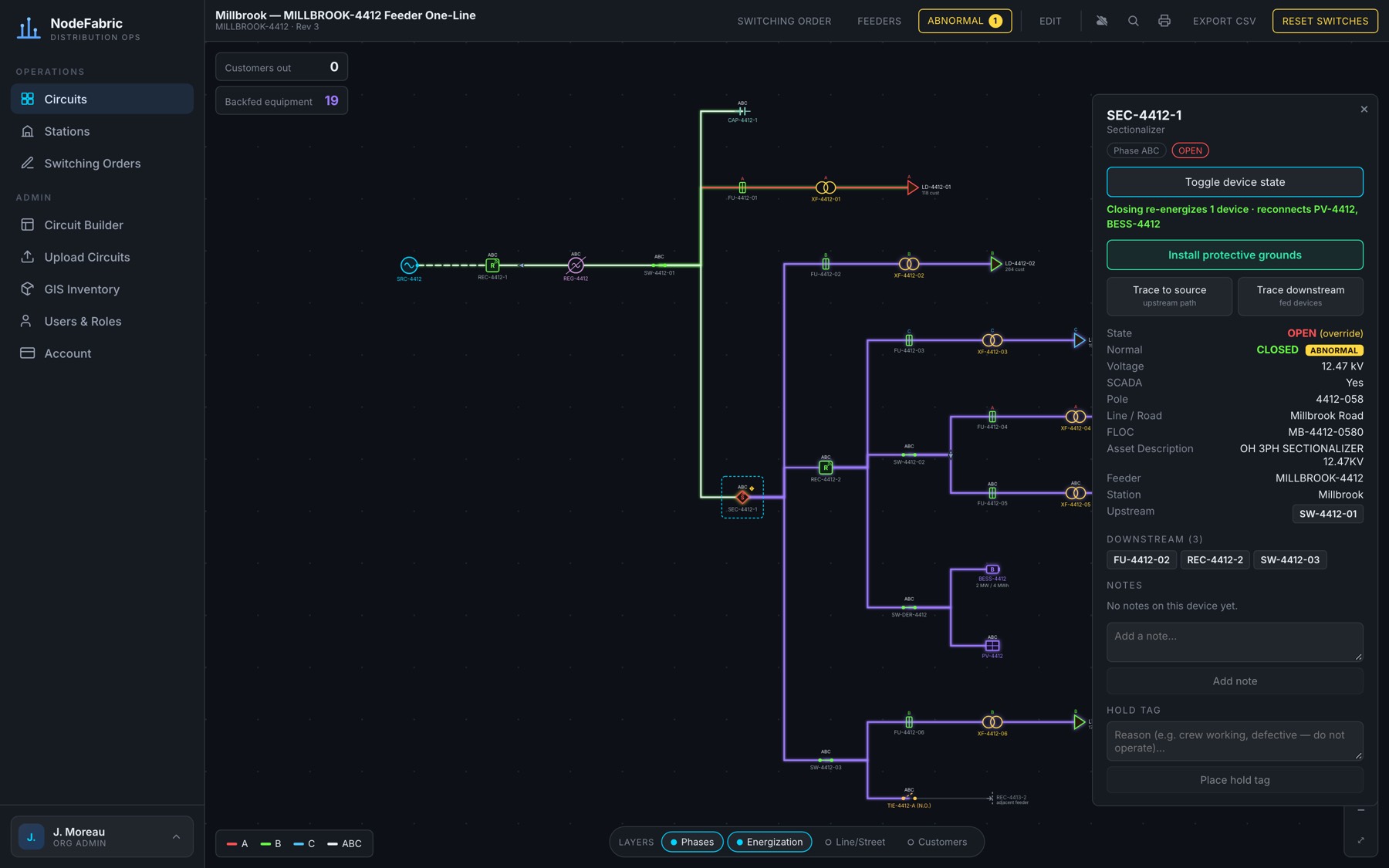
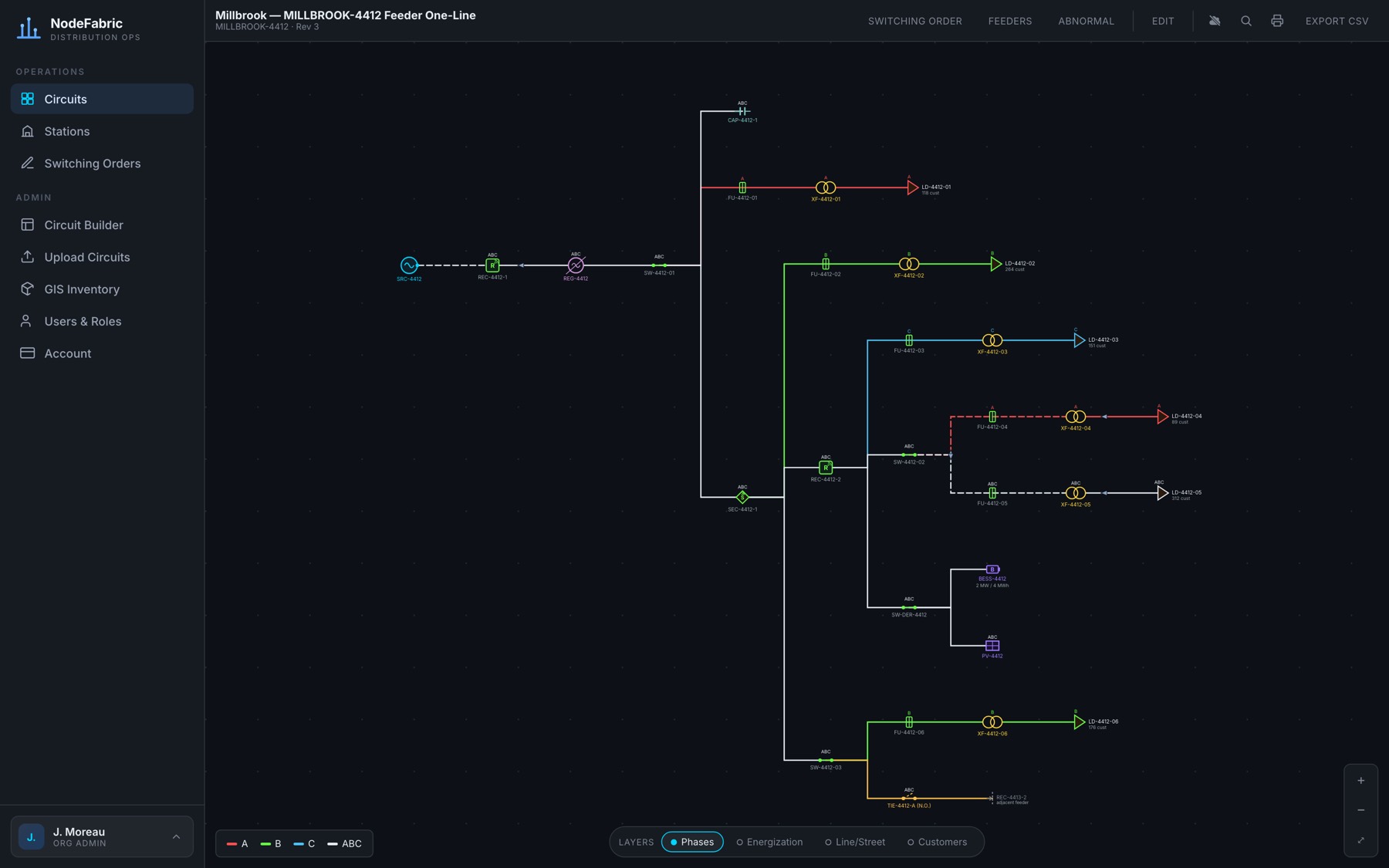
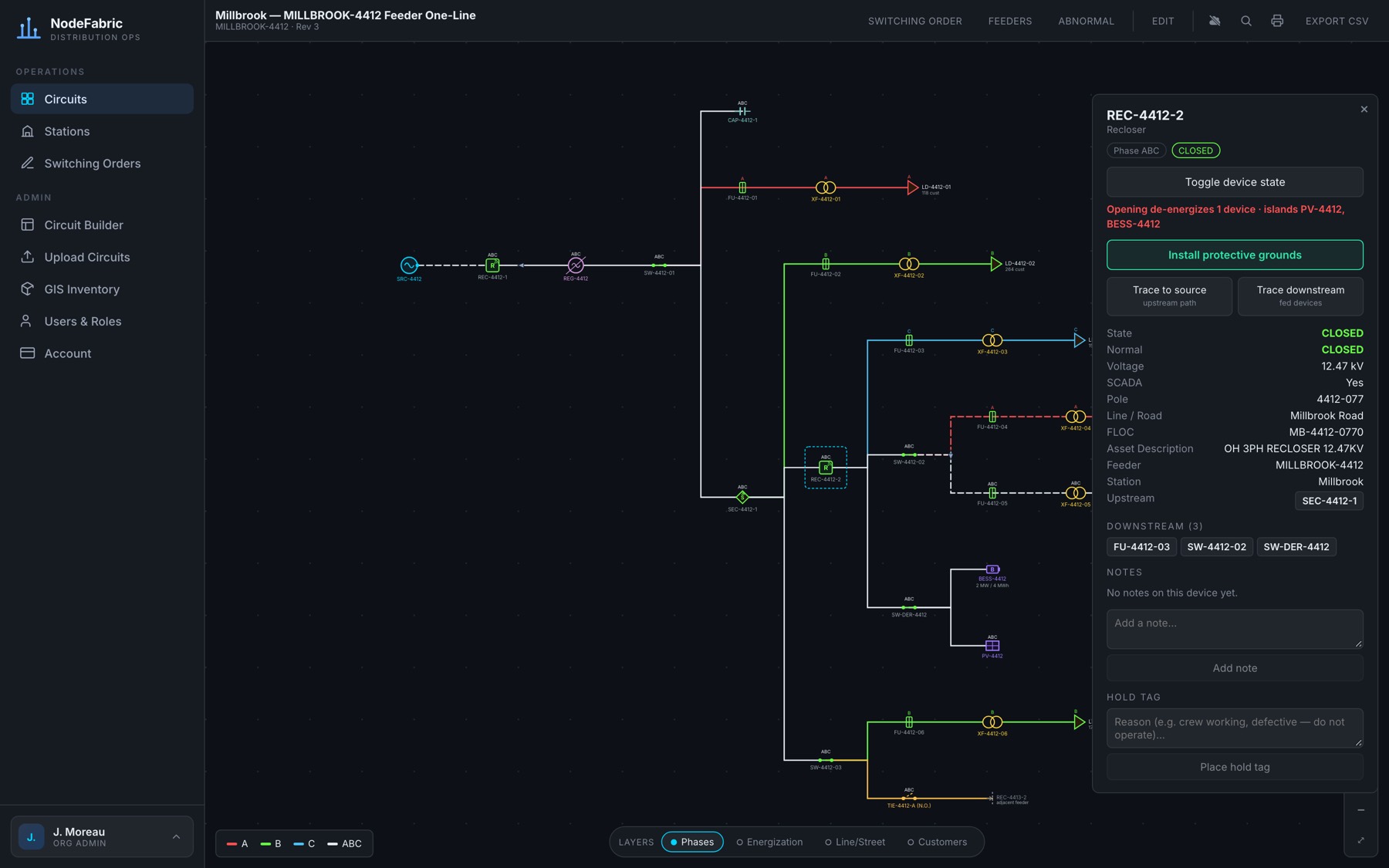
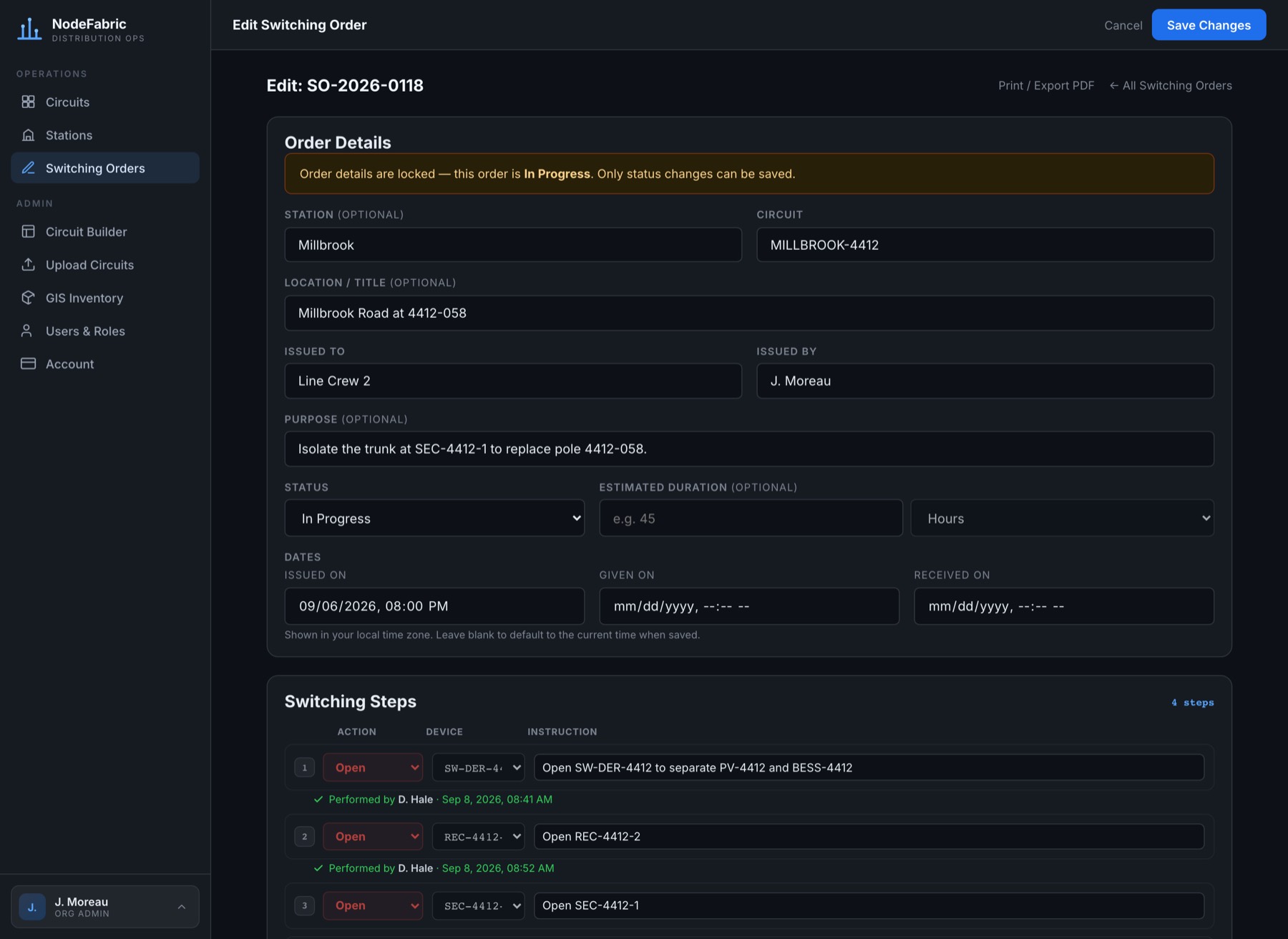
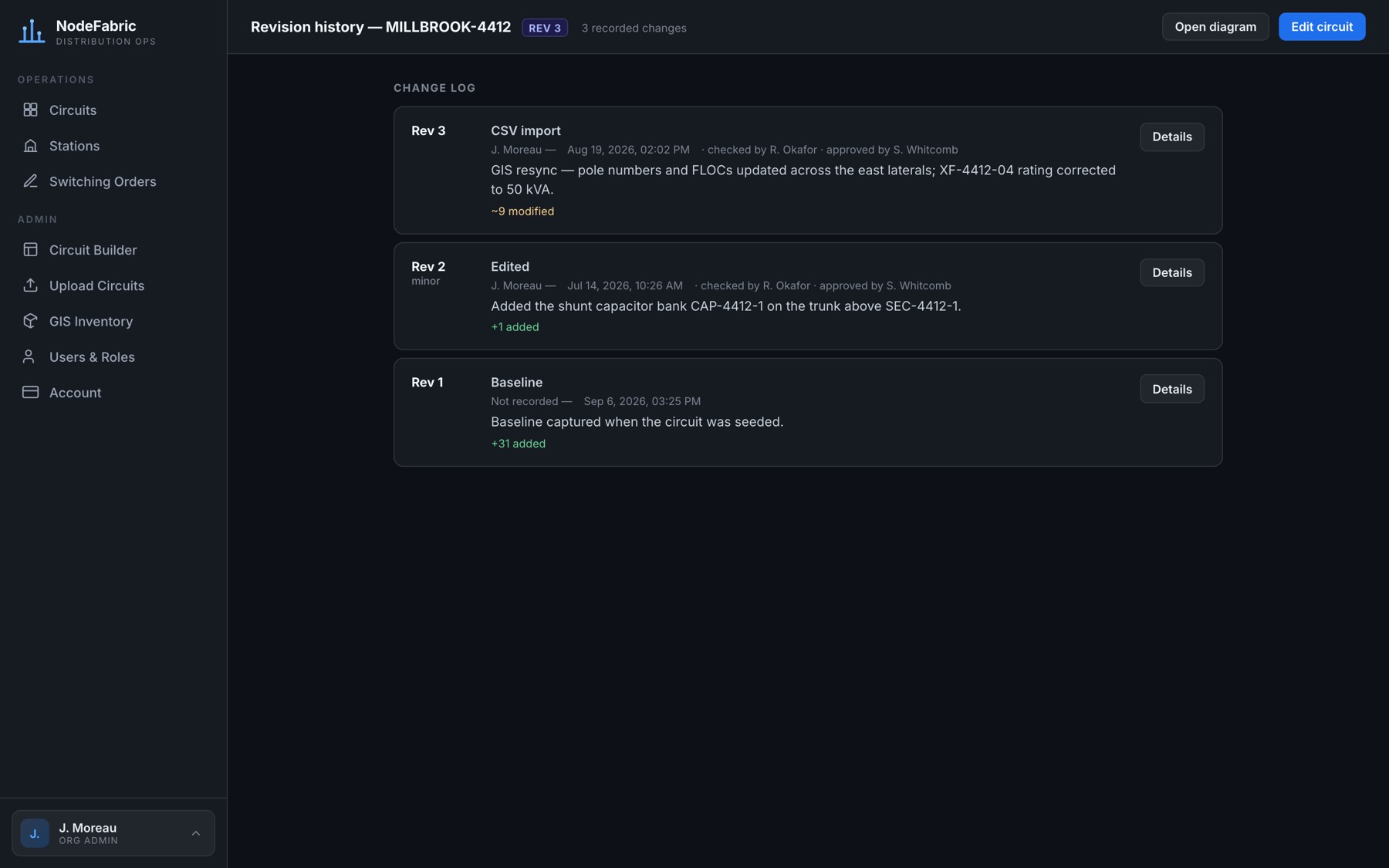
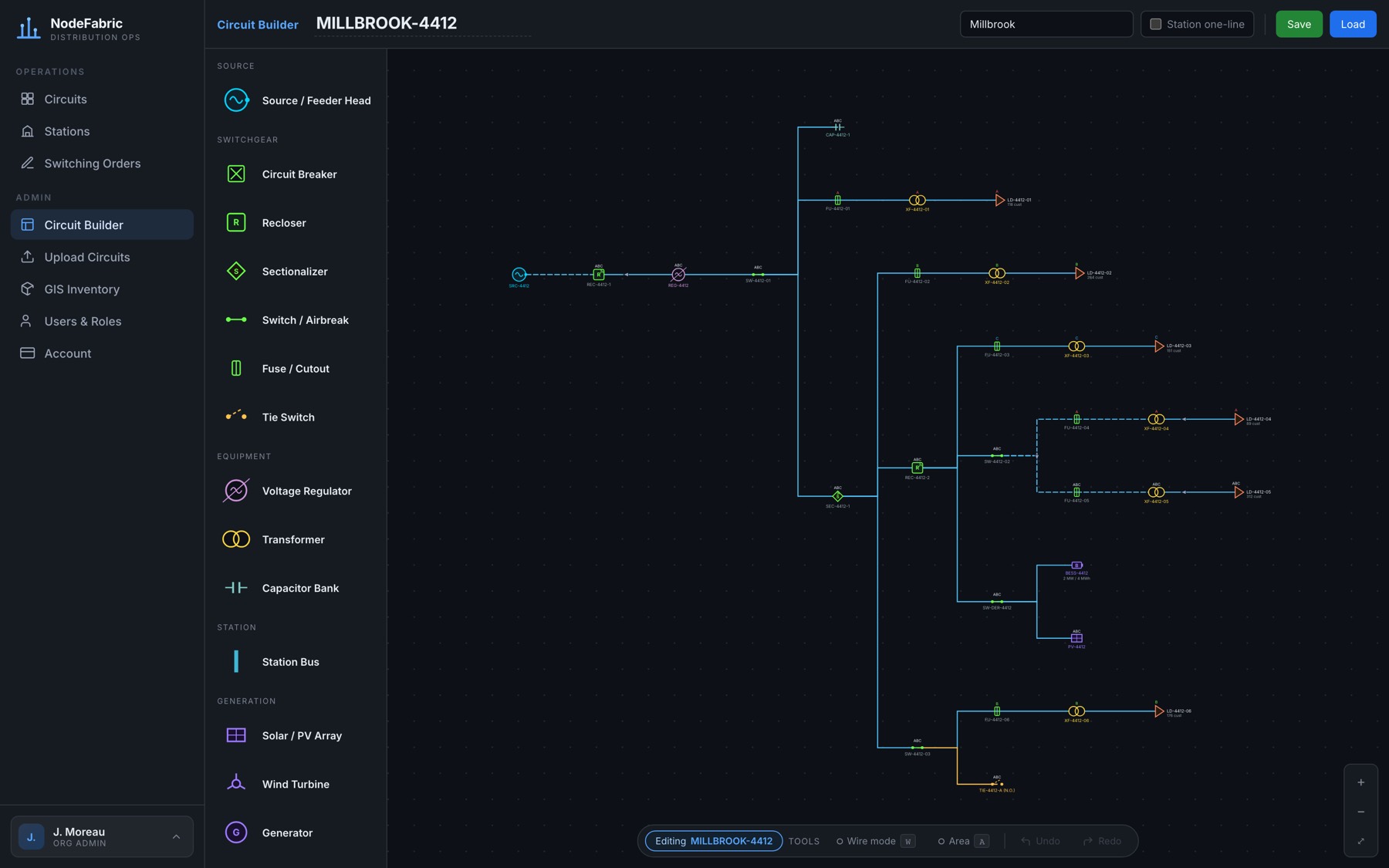
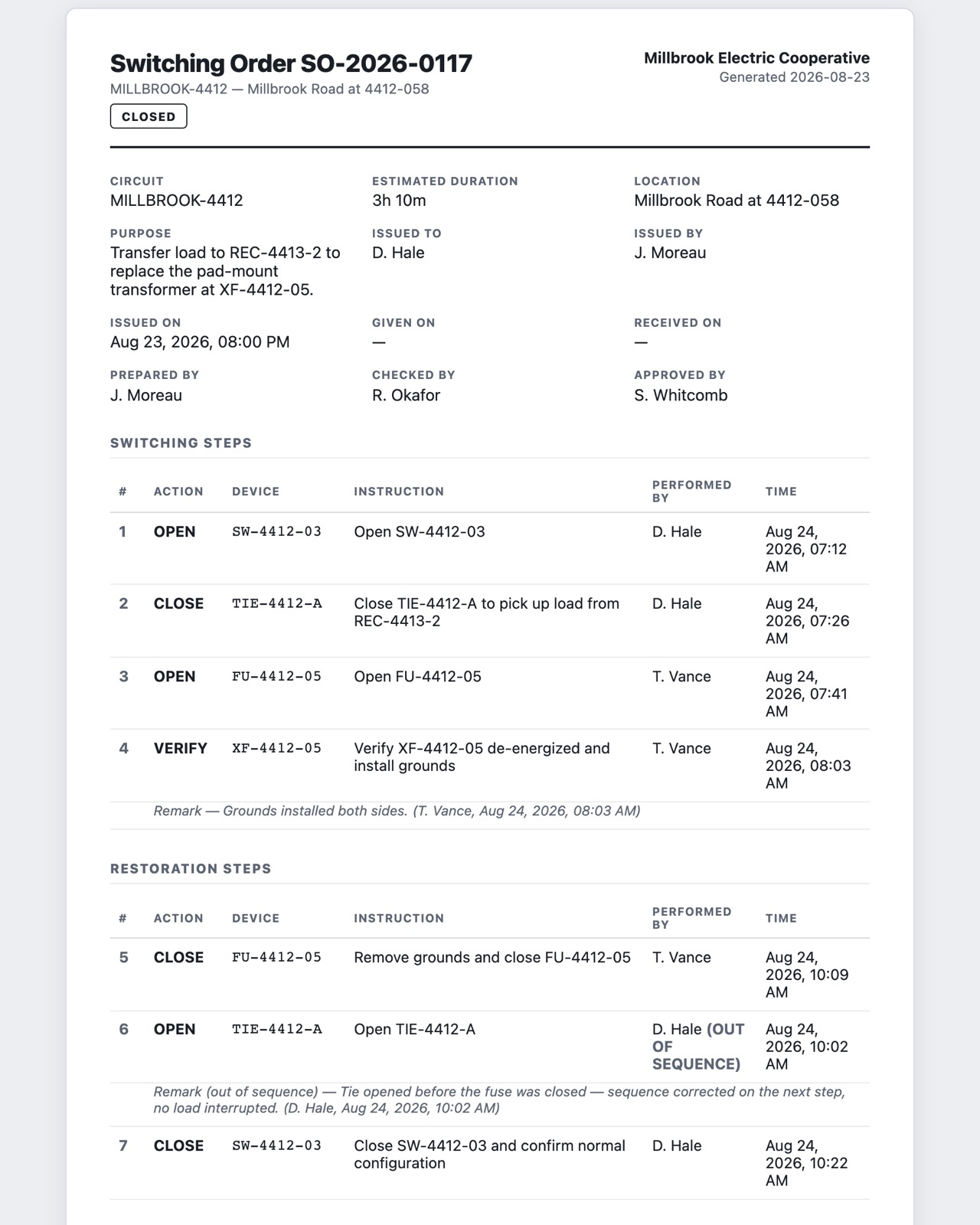
Captured from a running instance against Millbrook Electric Cooperative — a demonstration utility. Circuit, devices, orders and names are synthetic; no customer data appears on this page.
Scenario-based training built on the same one-lines your organization already uses operationally — not a generic simulator with someone else’s circuit.
Trainers build scenarios — including directly from real switching orders — and trainees practice against them without touching the live system. Performance is scored and tracked across scenarios over time, and certifications live alongside the training records with expiry reminders sent before they lapse.
Every Individual account starts with a 7-day free trial — no credit card required. Utilities are priced by system size on an annual agreement.
For solo engineers modeling circuits and trying NodeFabric before their team adopts it.
For utilities running switching across a full team — control room and field, priced to your system.
Tell us about your system and we will set up a walkthrough on your own circuits — then follow up with pricing and what a pilot looks like.
Already using NodeFabric? Sign in to the app.